Revision Thing
A history of the Iraq war, told entirely in lies
Posted on Monday, November 7, 2005. All text is verbatim from senior Bush Administration officials and advisers. In places, tenses have been changed for clarity. Originally from Harper's Magazine, October 2003.
By Sam Smith.
Once again, we were defending both ourselves and the safety and survival of civilization itself. September 11 signaled the arrival of an entirely different era. We faced perils we had never thought about, perils we had never seen before. For decades, terrorists had waged war against this country. Now, under the leadership of President Bush, America would wage war against them. It was a struggle between good and it was a struggle between evil.
It was absolutely clear that the number-one threat facing America was from Saddam Hussein. We know that Iraq and Al Qaeda had high-level contacts that went back a decade. We learned that Iraq had trained Al Qaeda members in bomb making and deadly gases. The regime had long-standing and continuing ties to terrorist organizations. Iraq and Al Qaeda had discussed safe-haven opportunities in Iraq. Iraqi officials denied accusations of ties with Al Qaeda. These denials simply were not credible. You couldn't distinguish between Al Qaeda and Saddam when you talked about the war on terror.
The fundamental question was, did Saddam Hussein have a weapons program? And the answer was, absolutely. His regime had large, unaccounted-for stockpiles of chemical and biological weapons--including VX, sarin, cyclosarin, and mustard gas, anthrax, botulism, and possibly smallpox. Our conservative estimate was that Iraq then had a stockpile of between 100 and 500 tons of chemical-weapons agent. That was enough agent to fill 16,000 battlefield rockets. We had sources that told us that Saddam Hussein recently authorized Iraqi field commanders to use chemical weapons--the very weapons the dictator told the world he did not have. And according to the British government, the Iraqi regime could launch a biological or chemical attack in as little as forty-five minutes after the orders were given. There could be no doubt that Saddam Hussein had biological weapons and the capability to rapidly produce more, many more.
Iraq possessed ballistic missiles with a likely range of hundreds of miles--far enough to strike Saudi Arabia, Israel, Turkey, and other nations. We also discovered through intelligence that Iraq had a growing fleet of manned and unmanned aerial vehicles that could be used to disperse chemical or biological weapons across broad areas. We were concerned that Iraq was exploring ways of using UAVs for missions targeting the United States.
* * *
Saddam Hussein was determined to get his hands on a nuclear bomb. We knew he'd been absolutely devoted to trying to acquire nuclear weapons, and we believed he had, in fact, reconstituted nuclear weapons. The British government learned that Saddam Hussein had recently sought significant quantities of uranium from Africa. Our intelligence sources told us that he had attempted to purchase high-strength aluminum tubes suitable for nuclear-weapons production. When the inspectors first went into Iraq and were denied-finally denied access, a report came out of the [International Atomic Energy Agency] that they were six months away from developing a weapon. I didn't know what more evidence we needed.
Facing clear evidence of peril, we could not wait for the final proof that could come in the form of a mushroom cloud. The Iraqi dictator could not be permitted to threaten America and the world with horrible poisons and diseases and gases and atomic weapons. Inspections would not work. We gave him a chance to allow the inspectors in, and he wouldn't let them in. The burden was on those people who thought he didn't have weapons of mass destruction to tell the world where they were.
We waged a war to save civilization itself. We did not seek it, but we fought it, and we prevailed. We fought them and imposed our will on them and we captured or, if necessary, killed them until we had imposed law and order. The Iraqi people were well on their way to freedom. The scenes of free Iraqis celebrating in the streets, riding American tanks, tearing down the statues of Saddam Hussein in the center of Baghdad were breathtaking. Watching them, one could not help but think of the fall of the Berlin Wall and the collapse of the Iron Curtain.
It was entirely possible that in Iraq you had the most pro-American population that could be found anywhere in the Arab world. If you were looking for a historical analogy, it was probably closer to post-liberation France. We had the overwhelming support of the Iraqi people. Once we won, we got great support from everywhere.
The people of Iraq knew that every effort was made to spare innocent life, and to help Iraq recover from three decades of totalitarian rule. And plans were in place to provide Iraqis with massive amounts of food, as well as medicine and other essential supplies. The U.S. devoted unprecedented attention to humanitarian relief and the prevention of excessive damage to infrastructure and to unnecessary casualties.
The United States approached its postwar work with a two-part resolve: a commitment to stay and a commitment to leave. The United States had no intention of determining the precise form of Iraq's new government. That choice belonged to the Iraqi people. We have never been a colonial power. We do not leave behind occupying armies. We leave behind constitutions and parliaments. We don't take our force and go around the world and try to take other people's real estate or other people's resources, their oil. We never have and we never will.
The United States was not interested in the oil in that region. We were intent on ensuring that Iraq's oil resources remained under national Iraqi control, with the proceeds made available to support Iraqis in all parts of the country. The oil fields belonged to the people of Iraq, the government of Iraq, all of Iraq. We estimated that the potential income to the Iraqi people as a result of their oil could be somewhere in the $20 [billion] to $30 billion a year [range], and obviously, that would be money that would be used for their well-being. In other words, all of Iraq's oil belonged to all the people of Iraq.
* * *
We found the weapons of mass destruction. We found biological laboratories. And we found more weapons as time went on. I never believed that we'd just tumble over weapons of mass destruction in that country. But for those who said we hadn't found the banned manufacturing devices or banned weapons, they were wrong, we found them. We knew where they were.
We changed the regime of Iraq for the good of the Iraqi people. We didn't want to occupy Iraq. War is a terrible thing. We've tried every other means to achieve objectives without a war because we understood what the price of a war can be and what it is. We sought peace. We strove for peace. Nobody, but nobody, was more reluctant to go to war than President Bush.
It is not right to assume that any current problems in Iraq can be attributed to poor planning. The number of U.S. forces in the Persian Gulf region dropped as a result of Operation Iraqi Freedom. This nation acted to a threat from the dictator of Iraq. There is a lot of revisionist history now going on, but one thing is certain--he is no longer a threat to the free world, and the people of Iraq are free. There's no doubt in my mind when it's all said and done, the facts will show the world the truth. There is absolutely no doubt in my mind.
About the Author
Sam Smith is the author of four books, the latest of which is Why Bother?: Getting a Life in a Locked Down Land. He is the editor of The Progressive Review.
Permanent URL
http://harpers.org/RevisionThing.html





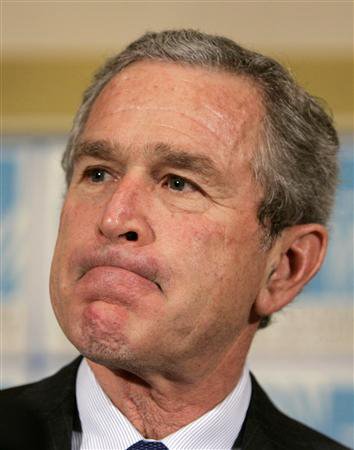 U.S. President George W. Bush listens to a question from the American media about his administration during the Summit of the Americas in Mar del Plata, Argentina November 4, 2005. REUTERS/Larry Downing