
Here's a couple more views from this South Sound vista:


Looks like they're making some preparations for more townhomes:

WASHINGTON -Had it been an isolated incident, the resignation from Congress of California Republican Randy "Duke" Cunningham after he admitted taking a $2.4 million bribe might have been a blip on the way to a special election.
IF the debate over the war in Iraq now raging across our front pages and airwaves proves nothing else, it already has demonstrated that this administration believes the people's attention span can be measured in nanoseconds and that memory has the shelf life of fresh bread.Link to entire article.
[...]
According to the vice president, "any suggestion that prewar information was distorted, hyped, fabricated by the leader of the nation is utterly false" and the product of a "self-defeating pessimism."
Really.
Just 24 hours earlier, The Times' Bob Drogin and John Goetz had described in vivid and convincing detail how the administration exaggerated and recklessly misused intelligence concerning Hussein's alleged manufacture of biological weapons that was provided by the now notorious Iraqi defector code-named "Curveball."
[...]
Deliberately falsifying history for mere political advantage is a particularly noxious social perversion. It is, to borrow, his stingingly apt adjective, "reprehensible."
But candid recollection and sober reflection do not amount to revisionism — unless, of course, you're already committed to self-deception and determined to convince others to live with your lie.
Fast forward to 1999. Britain's North Sea fields and the US's Alaska fields are in decline and their is a palpable sense of urgency regarding future energy needs within both the American and British governments. Dick Cheney, head of the Halliburton corporation and soon to be Vice President of the United States, declares "While many regions of the world offer great oil opportunities, the Middle East with two thirds of the world's oil and the lowest cost, is still where the prize ultimately lies," adding, "Even though companies are anxious for greater access there, progress continues to be slow." His governmental Energy Task Force is later to proclaim that "The [Persian] Gulf will be a primary focus of of U.S. international energy policy." Similarly, a British Foreign Office strategy paper identified a key objective of British foreign policy as to "improve investment regimes and energy sector management in these regions [the Middle East, parts of Africa and the former Soviet Union], focusing on key links in the supply chain to the UK."I am disgusted with America. Are Americans really too lazy and greedy to find alternatives that will lessen the demand for these global economy destabilizing petroleum products? The people's actions today, may be condemning future generations to a relative poverty. Think about it. How do you feel about that?
WASHINGTON — One hot, dusty day in June, Col. Ted Westhusing was found dead in a trailer at a military base near the Baghdad airport, a single gunshot wound to the head.Select this link for the remainder of the story.
The Army would conclude that he committed suicide with his service pistol. At the time, he was the highest-ranking officer to die in Iraq.
The Army closed its case. But the questions surrounding Westhusing's death continue.
Westhusing, 44, was no ordinary officer. He was one of the Army's leading scholars of military ethics, a full professor at West Point who volunteered to serve in Iraq to be able to better teach his students. He had a doctorate in philosophy; his dissertation was an extended meditation on the meaning of honor.
So it was only natural that Westhusing acted when he learned of possible corruption by U.S. contractors in Iraq. A few weeks before he died, Westhusing received an anonymous complaint that a private security company he oversaw had cheated the U.S. government and committed human rights violations. Westhusing confronted the contractor and reported the concerns to superiors, who launched an investigation.
In e-mails to his family, Westhusing seemed especially upset by one conclusion he had reached: that traditional military values such as duty, honor and country had been replaced by profit motives in Iraq, where the U.S. had come to rely heavily on contractors for jobs once done by the military.
His death stunned all who knew him. Colleagues and commanders wondered whether they had missed signs of depression. He had been losing weight and not sleeping well. But only a day before his death, Westhusing won praise from a senior officer for his progress in training Iraqi police.
[...]Link to the whole article.
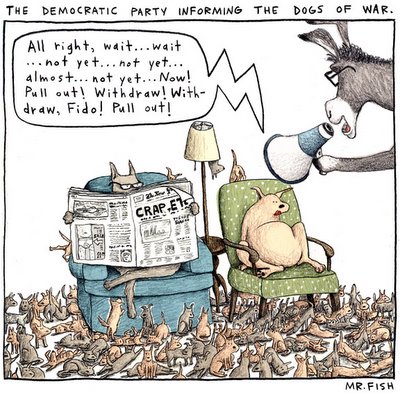
The longer the war goes on, the more Americans, "allies" and Iraqis will die. That is not a slam-dunk argument for ending this foreign entanglement. But it is worth keeping in mind while you try to decide whether American credibility or Iraqi prosperity or Middle East stability can justify the cost in blood and treasure. And don't forget to factor in the likelihood that the war will actually produce these fine things.
The last man or woman to die in any war almost surely dies in vain: The outcome has been determined, if not certified. And he or she might die happier thinking that death came in a noble cause that will not be abandoned. But if it is not a noble cause, he or she might prefer not to die at all. Stifling criticism that might shorten the war is no favor to American soldiers. They can live without that kind of "respect."


