31 October 2005

Calls for White House shakeup focus on Karl Rove

By Randall Mikkelsen
WASHINGTON (Reuters) -
U.S. President George W. Bush, whose top adviser Karl Rove remains in jeopardy in a CIA-leak probe, needs to shake up his White House staff if he hopes to revive a presidency reeling from multiple setbacks, Republican and Democratic lawmakers said on Sunday.
[snip]
Bush should take Cheney "to the woodshed" if necessary, a Democratic lawmaker said, and the Senate's top Democrat said Rove should be fired or quit.
[snip]

27 October 2005

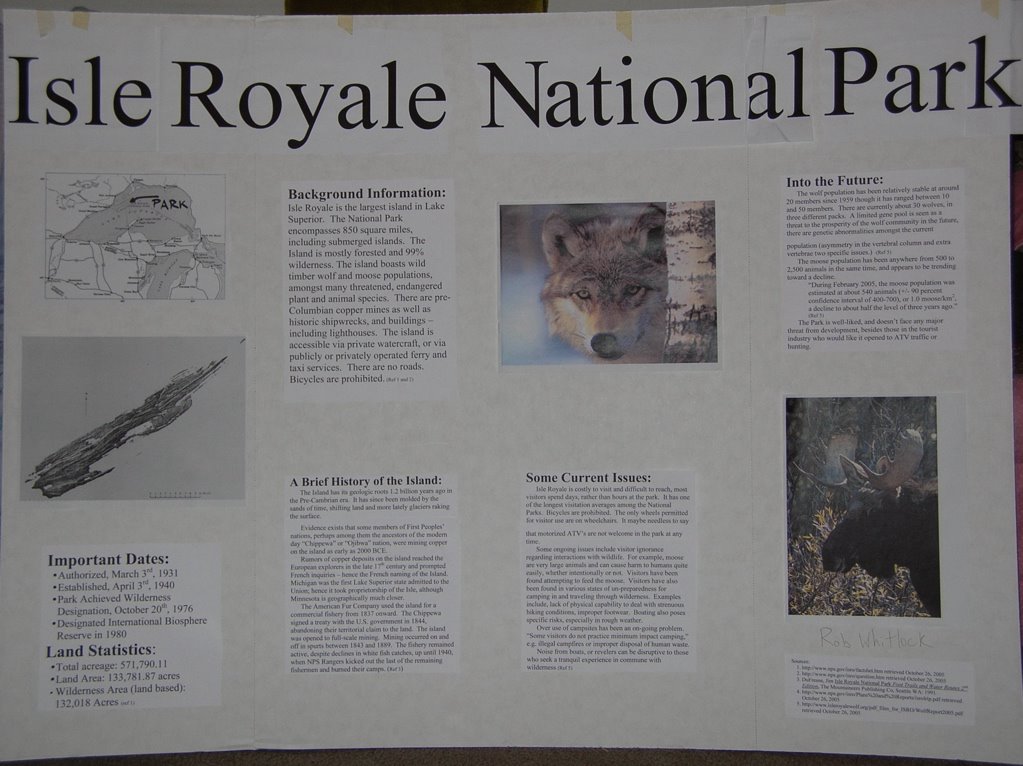
Isle Royale National Park Poster

Exxon Mobil posts record U.S. profit

By Deepa Babington
NEW YORK (Reuters) - Exxon Mobil Corp. on Thursday posted a quarterly profit of $9.9 billion, the largest in U.S. corporate history, as it raked in a bonanza from record oil and gas prices.

While profit was up 75 percent and revenue rose 32 percent to more than $100 billion, the results fell short of Wall Street forecasts due to production outages caused by Hurricanes Katrina and Rita and sharply lower profit at the company's chemicals division.


The rest of the article can be found here.

Dick Cheney's Song of America

Drafting a plan for global dominance

Posted on Wednesday, October 26, 2005. An essay exploring the real origins of the Iraq War, written before the war started. Originally from October 2002. By David Armstrong.


Few writers are more ambitious than the writers of government policy papers, and few policy papers are more ambitious than Dick Cheney's masterwork. It has taken several forms over the last decade and is in fact the product of several ghostwriters (notably Paul Wolfowitz and Colin Powell), but Cheney has been consistent in his dedication to the ideas in the documents that bear his name, and he has maintained a close association with the ideologues behind them. Let us, therefore, call Cheney the author, and this series of documents the Plan.

The Plan was published in unclassified form most recently under the title of Defense Strategy for the 1990s, as Cheney ended his term as secretary of defense under the elder George Bush in early 1993, but it is, like Leaves of Grass, a perpetually evolving work. It was the controversial Defense Planning Guidance draft of 1992—from which Cheney, unconvincingly, tried to distance himself—and it was the somewhat less aggressive revised draft of that same year. This June it was a presidential lecture in the form of a commencement address at West Point, and in July it was leaked to the press as yet another Defense Planning Guidance (this time under the pen name of Defense Secretary Donald Rumsfeld). It will take its ultimate form, though, as America's new national security strategy—and Cheney et al. will experience what few writers have even dared dream: their words will become our reality.

The Plan is for the United States to rule the world. The overt theme is unilateralism, but it is ultimately a story of domination. It calls for the United States to maintain its overwhelming military superiority and prevent new rivals from rising up to challenge it on the world stage. It calls for dominion over friends and enemies alike. It says not that the United States must be more powerful, or most powerful, but that it must be absolutely powerful.
The rest of the article can be found here.

[in case the previous link no longer works, here is an updated link: http://harpers.org/archive/2002/10/0079354]

26 October 2005

What the US death toll in Iraq reveals

A new poll shows that 53 percent of Americans say the war wasn't worth it.
By Dan Murphy | Staff writer of The Christian Science Monitor

BAGHDAD – Sometime in the coming days, the United States military will probably report the 2,000th American military death of the Iraq war.
While in some ways an arbitrary milestone, the tragic figure only tells part of the story when it comes to the human costs and human successes - both foreign and local - of the war.

Perhaps the most striking statistic from this war, compared with any other conflict in US history, shows troops today have a much better chance of surviving if wounded. This is because of vast improvements in body armor and strides in battlefield medicine.

For instance, the ratio of deaths to serious injuries in Iraq is less than half what it was in World War II. As recently as Vietnam, 28 percent of Americans hurt in action died. In Iraq, the ratio is 11 percent. In all, about 15,000 Americans have been wounded in combat here, about half of them seriously enough to go home.
Click here to read the rest.

25 October 2005

Condi Rice and Syrian Regime Change; Could Somebody Recommend a President?

By PAUL CRAIG ROBERTS
October 25th, 2005


Someone should tell Condi Rice that the gig is up. With the Bush administration dissolving in illegalities committed by key officials in their attempts to protect the lies that they used to justify the US invasion of Iraq, the secretary of state is trying to ramp up war against Syria.

Grasping a UN report that uses unreliable witnesses to implicate Syria in the assassination of a former Lebanese government official, Condi Rice told the BBC on October 23 that Syria's crime cannot be "left lying on the table. This really has to be dealt with."

This is amazing for many reasons. Here is the person in charge of US diplomacy acting as if she is the secretary of war unsheathing military force. Whoever heard of an American diplomat wanting to start a war because a former Middle Eastern government official was assassinated? Read the rest here.

23 October 2005

Death Up; Taxes Down

Bush, an Assessment
By SAUL LANDAU

[snip]

Rove has lowered his profile, but still maintains a grip on the prize: maintaining power. The power ethos links to the torture scandals at Abu Ghraib and Guantanamo. Defense Secretary Rumsfeld and White House Counsel Gonzalez both authorized such illegal behavior to control suspected terrorists.

Illegal and also inept! Bush played video golf for five days in Crawford while bodies floated down the flooded streets of New Orleans. The media finally began some critical coverage, noting the absence of the federal government in the place where people needed it most. It also re-discovered class and race. "Wow," said one of my students, "I didn't know that 37 million people lived under the poverty line." Indeed, the poor had remained especially invisible to the three million millionaires in the country who had grown richer through Bush's tax cuts.

[snip]

Read the whole article. [counterpunch.org]