Racial and economic justice, and the cessation of violent conflict! Abolition of an offensive economic, military-industrial establishment...
The enemy is not personnel. It is not personal. The enemy is ignorance. The enemy is fear, xenophobia, racism and other prejudice. The enemy is aggression and violence and hate.
Here are three copies of a video I recently made, my intent was to deal with the problem of an 'us v. them' mentality, privilege and oppression, wealth disparity, socio-economic harmfulness, and I suppose, violence in general.
Videos are below the fold.
Showing posts with label equality. Show all posts
Showing posts with label equality. Show all posts
05 March 2011

09 September 2010
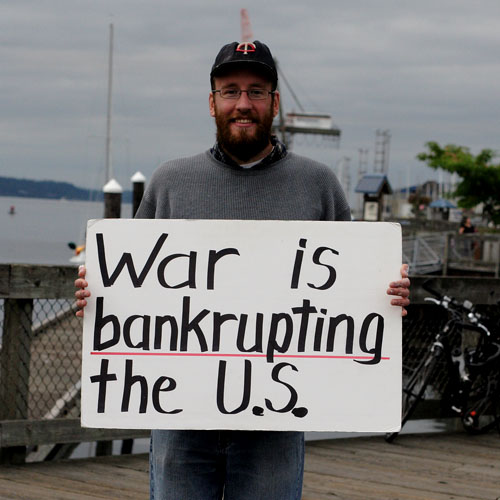
War is Bankrupting and Impoverishing Us
Friday 19 September 2008
Percival Landing Washington
War is a bankrupting activity. It bankrupts economically (financially, ecologically, etc.) And it bankrupts morally.
There are some anti-war quotes attached to this photo where it's linked from on the flickr site, and I am reminded of another quote by the Rev. Dr. MLK Jr.:
A nation that continues year after year to spend more money on military defense than on programs of social uplift is approaching spiritual death.
Which reminds me that I recently read Stride Toward Freedom by MLK. It's about the Montgomery bus boycotts of 1954-55. I thought it was a great read. Why? A number of reasons. For starters, it was clearly written, and also of compelling content. It's the story of Southern Black Liberation—a story that is ongoing today—and it's roots are in campaigns like the one described in the book by MLK.
Rosa Parks and MLK are popular figures in America. For example, many cities have major thoroughfares buildings named after MLK. That's pretty high esteem for a radical revolutionary. Because that's what MLK was. He was a radical, and a revolutionary. Even at the age of 26, in 1954, he understood the cause of so much violence and disease (including racism) was fear, and distrust/mistrust between people, and the repetition of old patterns of behavior, patterns that really just don't make sense—and he also understood that the vast and growing discrepancy in wealth between global rich as a root-level cause of war and other violence.
By the time that MLK was assassinated in 1968, I think he may have even moved in his political views further toward the left of liberation, that is the liberation from oppression for all people—and he criticized the war in a very meaningful and fundamental way, calling into question national aggression, and calling for a movement to counter the rampant "militarism, materialism, and racism" prevailing in society.
I recommend the Speech, Beyond Vietnam, which was delivered a year to the day before he was killed.
Seeking to address the root cause of violence, disease and poverty, MLK stated in the speech that: "True compassion is more than flinging a coin to a beggar. It comes to see that an edifice which produces beggars needs restructuring."
Another statement from the speech:
"I was increasingly compelled to see the war as an enemy of the poor and to attack it as such." MLK Jr.
Following is a link to audio of the speech, and then the text. Please take a listen!
03 September 2010
Include Everyone!
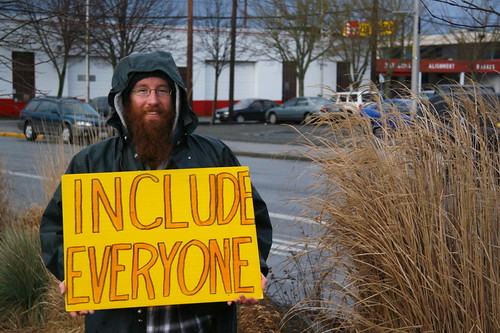
I was reminded of this concept of including everyone by an article I read in the Progressive magazine. It's a book review by Ruth Conliff. Richard Wilkinson and Kate Pickett have researched the effects of socio-economic equality on people's health, and have desecribed their work in a new title, The Spirit Level: Why Greater Equality Makes Societies Stronger. I wrote a blog about that on OlyBlog here.
Here are a couple more photos, with peace, Berd

06 September 2009
Socio-economic Inequality
This is from the September 2009 issue of The Progressive Magazine, an article called "Wall Street's Gall, by Les Leopold:
• In 1970, the ratio of the top100 corporate CEOs and the average worker's pay was 40 to 1. By 2007 it was 1,723 to 1.simply, yet absolutely, astounding - mind boggling
• In 1970, the top 1 percent received 8 percent of the national income. By 2007, it was gobbling up 23 percent of the national income.
• In 2006, the top one-tenth of 1 percent of tax payers (about 140,000 tax returns) reported as much income as the bottom 50 percent (67.4 million tax returns). The last time we suffered from such an extreme income distribution? 1928-29.
...
03 September 2009
A Sustainable Prosperity for All People
 It is so sad that people put economic self-interest ahead of concern for the well-being of others. It has always been immoral to oppress, to exploit, to harm and injure, to enslave, to in any way put down others - either for economic self-interest or otherwise.
But while it has always been immoral and problematic - these injustices, however intolerable they were at the time, have never been a threat to the survival of human beings on the planet in the same way that they are now.
Ever since the industrial revolution, the impact of human activities on the world has increased at an ever expanding rate. The human population has grown many times over in the past 200 years. The level of human technology has developed at a phenomenal rate. So that now we are at a place in our development where we very seriously face a level of environmental degradation that has the potential to cast our very own species into a very problematic place.
Members of our species are engaged in fighting wars on massive scales, killing each other over control of land and resources.
In the past these wars were certainly destructive. But until the last few decades, these wars and industrial activities have not borne the capacity to put the survival of the human species in their cross-hairs of destruction.
 What we have now is not only immoral, but impending economic/ecological disaster on a large scale. The air, water and land upon which we depend are being polluted. The pollution is of a scale that is threatening - it is threatening our survival on a very real level.
So change is no longer only a moral imperative. It's not only a matter of ethical values. It's not only about kindness and reciprocity. It's about economic reality. It's about survival.
It's sad that it has come to this. People are dying. If humans are so smart, why isn't society set up to serve life - and to serve people? Why do we have a society that is designed to serve capital? Why are we slaves to capital. It's bogus. And the only reason it's like this is so that some few can have power over so many.
People, we need to stand up and learn to take back control of our governmental institutions. We need to take our government, our society, our community, our culture, our lives, our loves, and our families back, to take it back from the giant corporations.
It's not just about morality and doing what is right. It's about survival. I want to confront the tyranny in our society. To confront the tyranny that is killing people, killing eco-systems, killing plant and animal species. Lay it out bare.
This society is a killing society, this economy is a killing economy. This culture is laying waste to the resources of this planet. Mineral resources are being consumed at an astronomical rate. Will our gifts to future generations survive a legacy of profligacy and tyranny?

The moral argument is strong. Society should never have gotten to this point - where people lie, and cheat, and steal from each other - where people abuse, and threaten, and beat up on, and kill each other. It shouldn't be this way. But now there is an economic imperative. There is the pressure of survival. There is the reality of pending energy shortages.
Something must be done.
A friend lent me a book I that I am interested in exploring in detail, it's called THE TRANSITION HANDBOOK: From oil dependency to local resilience, by Rob Hopkins, who is the Founder of the Transition movement.
I tend to think that the solution exists on the local level. So I probably already agree with most of what Hopkins has to say on this matter.
Well that's my socio/political/economic rant for the day.
01 May 2009
Somebodies and Nobodies: Overcoming Abuse of Rank
This is a description of a great book I was recently turned onto. It's about rankism. It is a very interesting topic. I have browsed in this book, it's available on google reader, and I have found it very compelling. The author doesn't argue against rank, hierarchy, or the existence of authorities. What he does argue against is what he describes as a culture of abuse that has developed around rank. People abuse their rank to the detriment of others. Essentially, people use their rank to hurt others. It's not right to hurt other people. Pretty simple idea. I think it's possible to have a world where people don't behave in ways that are hurtful/harmful toward each other. - Berd
Somebodies and Nobodies
Overcoming the Abuse of Rank
By Robert W. Fuller
In the on-going attempts to overcome racism and sexism in North America today, we are overlooking another kind of discrimination that is no less damaging and equally unjustifiable. It is a form of injustice that everyone knows, but no one sees: discrimination based on rank. Low rank -- signifying weakness, vulnerability, and the absence of power -- marks you for abuse in much the same way that race, religion, gender, and sexual orientation have long done.
When discrimination is race-based, we call it racism; when it's gender-based, we call it sexism. By analogy, rank-based discrimination might be called "rankism." Somebodies and Nobodies explains our reluctance to confront rankism, and argues that abuse based on power differences is no more justified than abuse based on color or gender differences. It shows where analyses based on identity fall short and, using dozens of examples to illustrate the argument, traces many forms of injustice and unfairness to rankism.
Somebodies and Nobodies unmasks rankism as The Feminine Mystique unmasked sexism. It demythologizes the prevailing social consensus -- the "Somebody Mystique" -- to demonstrate the pervasiveness and corrosiveness of rankism in our personal lives and social institutions. The book introduces new language and concepts that illuminate the subtle, often dysfunctional workings of power in our social interactions. It presents rankism as the last hurdle on the long road from aristocracy to a true meritocracy, brings into focus a dignitarian revolution that is already taking shape, and offers a preview of post-rankist society.
About the Contributor
Robert Fuller taught physics at Columbia University in New York, where he co-authored the classic text Mathematics for Classical and Quantum Physics. He then served as president of Oberlin College and, subsequently, worked internationally as a 'citizen diplomat' to promote democracy in developing nations. He has four children, and lives in Berkeley, California.
Visit Contributor's Website

Subscribe to:
Posts (Atom)