Showing posts with label environmental justice. Show all posts

12 July 2010

Ship in Port, with Ideas about Success, Materialism, Society, and Health

Log Export
July 10, 2010
view original size

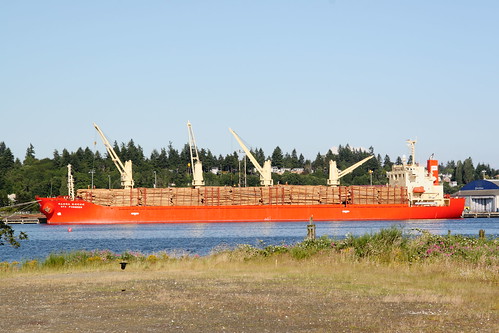
A ship carrying logs is seen at the Port of Olympia, in the City of Olympia, Thurston County, Washington State. The ship is the STX Pioneer, of Panamanian registry.

Despite the many faceted objections of environmentalists, the Weyerhauser company has teamed up with the public sector and is operating a log export operation at the Port of Olympia.

Many people who understand and care about the environment object to the activities of the Weyerhauser company. The lists of reasons is long. The objections stem at least in part because of the fact that the logging operation is harmful to ecosystems. The logging and shipping imperil the delicate biodiversity that is at the heart of ecosystem health. This goes along with a number of other reasons to object to the log export operations, including but not limited to the environmental effects from the transport of such a heavy commodity over long distances.

Should companies be allowed to engage in activities that harm the environment?

Who does the environment belong to? Or rather, who ought the environment belong to? (To some and not others? To all? To none?)

When there are harmful industrial activities, does it make more sense that some few should benefit disproportionately more than others, or does it make more sense to distribute the wealth in a way so that everyone would benefit equally?

Does the focus on a definition of success that leans on the metrics of materialism (v. spirit, or community, for example) promote a fundamentally harmful, abusive, violent relationship with the material of existence, the substance of the planet?

Is it possible that there other ways of defining success that would be more favorable toward a vision of economic stability and justice, and toward an end to what many believe is the criminal behavior of big companies?

In of the current system societies are engaged in competition to exert control over resources. Instead of this scenario, think about societies moving toward a culture of cooperation and stewardship and mutual prosperity. Think about society moving away from a culture of war, conquest and dominance.

Instead of measuring success based solely on personal material riches, perhaps success could be defined along the lines of a healthy community, on the ability to take care of each other, and to be truly aware and awake, conscious (and conscientious) in our daily lives, so that we are careful to the greatest extent possible to NOT do harm...

Perhaps success could be defined along the lines of efforts to strengthen the fabric of society, to work toward an end to all violence, and an end to all unnecessary suffering - an end to poverty, starvation, illiteracy, homophobia, sexism, ageism, racism, nationalism.

Perhaps success could be defined along the lines of contribution to the mutual health and well-being—the mutual happiness and prosperity—of all people.

Berd

26 June 2010

Detroit Incinerator Protest

Saturday, June 26, 2010, Detroit—Protest against Detroit incinerator. We were told that this is the "largest incinerator in the world." It's a privately owned for-profit company that does the job. It's called Covato, or something like that. I'll look it up and make any corrections.

Also, it's hard to see smoke, but there is a nasty odor in the exhaust plume. I wonder if the particularly nasty stuff gets burned at night, or if the smoke has been cleaned up for the presence of out-of-towners with the forum this week. There was a very nasty odor when we walked downwind of the facility.

Detroit doesn't have a recycling program, so waste plastic, styrofoam and other toxics may very well be included in the waste that is burnt at the incinerator. Disgusting thought.

One organizer mentioned the concept of Zero Tolerance: There is no safe, nor allowable level for toxic emissions. Any toxins are unacceptable. For example, if the incinerator releases even one particle of dioxin, then it must be shut down. I agree. Especially if it is run for-profit.

No one deserves to profit from activities that do harm.

It was a great protest, I have a ton of photos. More later!

[more photos from the protest here: //peacepotential.blogspot.com/2010/07/more-photos-from-detroit-incinerator.html]

08 June 2010

Can Capitalism Be Altruistic?

Ralph Nader's New Book
view larger

This book, "Only the super-rich can save us," by Ralph Nader, came out last year.

I think Ralph Nader is a brilliant thinker. I credit Ralph with initiating my own political awakening, to the harmfulness that is intrinsic to this corporate power dominated political system. These corporations compete for market domination. They can do no less - or else they would not be wise investments. Dominate to succeed. It's an unnatural and inharmonious system. Human beings have too much control over the environment to have a system that promotes and encourages the dominator paradigm. Another way is possible. A better way. A way of altruism, respect, kindness, compassion, reciprocity, truth, and peace....

Here are some of my initial thoughts about this book, I posted these on the facebook website earlier today:

I'm reading this new book by Ralph Nader. I'm about a chapter into it, "Only the super-rich can save us."

I think Ralph is brilliant, and I enjoy what seems, so far, to be the sense of humor in this book. However, there are some questions I have about the vision Ralph presents in this book, and although I am curious ab...out whether my questions will be addressed in this nearly 800 page epic, I am also skeptical.

The book presents Ralph's fictional (though he thinks plausible) scenario in which some of the world's richest philanthropists suddenly wake-up and realize how fucked-up the world is. Because of this realization, and the realization of their potential ability to make change, they therefore dedicate themselves, under the leadership of one mega-billionaire Warren Buffet, to use their capital, and other influence, toward the creation of an "open society" -a society that is altruistic and benevolent.

My question relating to the plausibility of this scenario revolves mostly around the realism of an expectation for reform within the capitalist (corporate socialism/ fascist) economy that we have.

It seems to me that capitalism has always been abusive. It seems to me that capitalism has always been exploitative and violent (slavery, extinction of species, et al.). It seems to me that on at least some level capitalism has always involved the mentality of divide and conquer. It seems to me that capitalism has always been oppressive.

So, so far the book is interesting, and I really appreciate what I think is Nader's sense of humor. About 40 pages into it, and I think it's an entertaining and interesting, crafty literary work of prose, albeit with a narrative that is sometimes somewhat silly, (an aspect which I personally find to be charming.)

But the question remains... is capitalism reformable? Is it possible to practice an altruistic capitalism? Or is the tendency to pit people against each other a radical and undeniable basic feature of the capitalistic economic system?

Is the concept of altruism anathema to capitalism (especially one that thrives on materialism/commercialism/consumerism)?

28 May 2010

Following BP (it's a disaster - a volcano - not a "spill" nor a "leak" - a major man-made volcano!)

What a mess. At least now there is more information coming out about the lead up to the disaster, and how BP has a record of operating out of compliance with safety regulations.

So we can see how a corporation puts profit before the precautionary principle, and before the interests of life and health.

I am going to drop a few links here to articles that I think are important in terms of developing a more full understanding of the background and full scope of this disaster.

From Truthout.org: Ex-EPA officials ask why isn't BP under criminal investigation

Greg Palast: BP's other oil mess this week

NYT: Photo gallery

Video: what BP does not want you to see

Democracy Now! Oil disaster responders being hospitalized due to toxic exposure

Could the problem have been avoided?

NYT: Panel finds BP had evidence of problem with oil well long before disaster

NYT: Documents show earlier worries about safety of rig

What if BP let the disaster happen intentionally...

Does it make sense for people to profit from environmentally destructive activities?

23 May 2010

Angela Davis and Antwi Akom at Evergreen

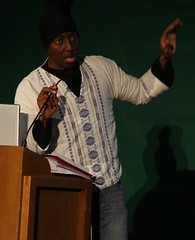
On Saturday, May 22, 2010 Antwi Akoma and Angela Davis appeared at the Evergreen State College near Olympia, Washington. The two were invited to speak by the Student of Color Union and Synergy (which is a week-long conference about eco-sustainability.)

There were close to two thousand people in attendance. Here's Angela Davis on stage in the CRC gymnasium:
Audience in CRC

Angela Davis
Angela Davis's speech focused on problems relating to the punitive justice system, and ranged broadly on specific topics relating to the injustices of structural socio-economic racism and inequity, privatization of the prison industry (and higher education,) as well as the problems of ecological unsustainability as they relate to capitalism and a corporate culture that favors profits over human rights, economic justice, ecological sustainability, healthy individuals and a healthy environment.

Antwi Akom
Antwi Akom's speech focused on addressing the problem of "eco-apartheid" —a term Akom used to elucidate upon the problem of environmental racism. Akom's speech was titled "Race, Power, and the Environment: Creating a New Global Vision of Equity and Sustainability for All".

14 February 2010

Rally Against the NW Immigration Detention Center

No Mas Deportaciones! Justicia Ya! Saturday, February 13, 2010

Tacoma, WA - People came from near and far (Tacoma, Seattle, Olympia, and Portland) for a protest rally against the Immigration and Customs Enforcement Detention Center in Tacoma, Washington. The detention center is run for-profit, by The GEO Group Inc. According to the description on company's website:

11 February 2010

Do Ecosystems Have Rights?

Why do corporations have rights when living ecosystems do not?

Please watch this very important, interesting, and powerful speech by Mari Margil.

Mari Margil speaks to the 2009 Bioneers conference in the spirit of The Lorax:
Protecting Against Environmental Degradation by Recognizing the Rights of Nature

I am also reminded about another set of important videos that have powerful ideas to share.

The Story of Stuff. And also The Story of Cap and Trade.

There are also a couple other videos in the production queue.

This is really really awesome work by Annie Leonard. Please also take time to see these important videos. http://www.storyofstuff.com/

It's all good food for thought.

04 February 2010

Ecopsychology

I am profoundly affected by the environment. Environmental degradation makes me sad. Environmental degradation makes me sick.

I am signed up on an eco-psychology listserve, so I receive articles forwarded from similarly minded and interested people all around the world. That's how I was alerted to the following article in the NYT Magazine. I haven't read the whole article, but it's nice to see the field of eco-psychology in the somewhat mainstream press (not that the NYT Mag is exactly mainstream.) Well you get the idea.

Here's a link: Is there an ecological unconscious?

15 December 2009

The Story of Cap and Trade Video

This is a great video. A must see.

Here's a comment I left on youtube:
The wealth of developed nations is based not only on ingenuity and hard work. The wealth of developed nations is also critically based on oppression and violence, including slavery and environmental degradation (greenhouse gas pollution very much included.)

The myth of meritocracy runs rampant in American culture.

It's important to realize that much of our material "success" is based not on merit - but instead on oppression and violence, on expropriation and exploitation.

The video:

The Story of Cap and Trade